Hexabot v3 Is Here: From Chatbot Builder to Agentic AI Workflow Automation Platform
Discover how Hexabot is evolving from a chatbot builder into a self-hosted AI automation platform for building agentic workflows across channels.

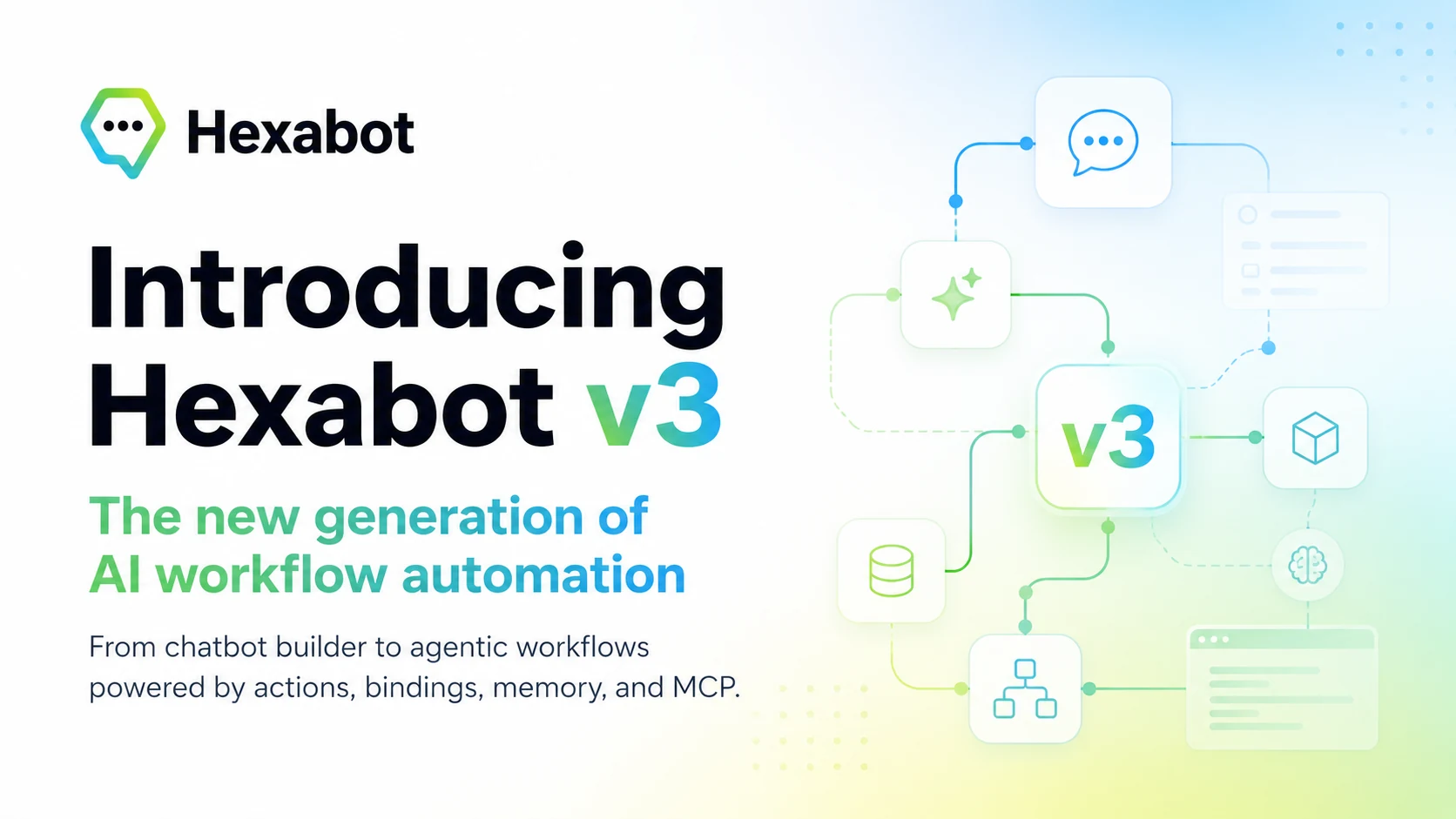
Today, we are excited to introduce Hexabot v3, a major new generation of Hexabot.
This release is more than a technical upgrade. It represents a significant product repositioning: Hexabot is evolving from a classic conversational AI builder into a self-hosted AI workflow automation platform designed for developers, automation builders, agencies, and teams who want more control over how AI is used in real business workflows.
Hexabot started with a clear mission: help teams build powerful conversational experiences across channels. With v3, we are expanding that mission.
The future of automation is not only about chatbots. It is about connecting conversations, business logic, tools, memory, AI reasoning, human review, and scheduled processes into reliable workflows.
That is exactly what Hexabot v3 is built for.
Why Hexabot v3?
AI automation is moving fast.
Many teams are experimenting with AI agents, workflow builders, LLM-powered assistants, and tool-calling systems. But as these systems become more powerful, they also create new challenges:
-
How do you keep automation reliable?
-
How do you avoid making the LLM reason through every deterministic step?
-
How do you combine AI decisions with structured business logic?
-
How do you connect conversations to real actions?
-
How do you maintain control over costs, data, deployment, and extensibility?
Hexabot v3 was designed around these questions.
Instead of treating AI automation as a black box, Hexabot gives developers a structured way to design, run, extend, and control agentic workflows.
The goal is simple: combine the flexibility of AI with the reliability of software engineering.
From Conversational Flows to Agentic Workflows
In previous versions, Hexabot was mainly understood as a chatbot builder.
The core concepts were familiar to anyone building conversational automation: flows, blocks, conversations, plugins, and channels.
That model worked well for chatbot-first use cases. But modern AI automation needs a broader foundation.
With Hexabot v3, the center of gravity has changed.
Hexabot is now organized around:
-
Workflows: structured automation definitions that describe what should happen.
-
Actions: reusable execution units that perform real operations.
-
Bindings: reusable configuration and capability definitions.
-
Memory: explicit memory definitions for AI-powered workflows.
-
Channels: communication interfaces that connect workflows to users.
-
MCP integration: support for Model Context Protocol interoperability.
In other words, conversation is no longer the whole product.
Conversation is now one possible mode of automation.
A workflow can be conversational, manual, scheduled, or triggered by other automation patterns. This makes Hexabot much more flexible for real-world use cases such as customer support triage, lead qualification, CRM updates, internal operations, reporting, and AI-assisted business processes.
YAML Workflows: A More Developer-Friendly Foundation
One of the biggest changes in Hexabot v3 is the introduction of YAML-based workflow definitions.
This gives developers a clearer and more portable way to define automation logic.
Instead of relying only on a visual builder, teams can now express workflows as structured definitions. This makes automation easier to review, version, document, and maintain.
For developer teams, this matters a lot.
Workflows can now become part of the engineering lifecycle. They can be reviewed in pull requests, stored in repositories, tested, reused, and evolved over time.
This also makes Hexabot more aligned with how modern software teams already work.
Actions: Extensibility That Feels Like Software Engineering
In Hexabot v3, actions become a central extension mechanism.
An action is a reusable unit of work. It can call an API, transform data, create a ticket, send a notification, update a CRM, fetch information, or execute any business operation your workflow needs.
This is important because not every step should be handled by an LLM.
Many workflow steps are deterministic. For example:
-
Creating a HubSpot lead
-
Sending a Slack notification
-
Searching a product catalog
-
Updating a support ticket
-
Checking an order status
-
Scheduling a meeting
-
Fetching data from an internal API
These steps should be implemented as reliable actions, not repeatedly reasoned through by a language model.
This is one of the core ideas behind Hexabot v3: use AI where AI adds value, and use structured actions where reliability matters.
That balance helps teams build automation systems that are more predictable, more maintainable, and easier to control at scale.
Memory and Context for Smarter Automation
AI workflows often need context.
They may need to remember user preferences, conversation history, previous decisions, customer status, or domain-specific information.
Hexabot v3 introduces memory as a more explicit domain concept. This makes it easier to design workflows that can use memory intentionally instead of treating it as an invisible side effect of the conversation.
For AI automation builders, this opens the door to more advanced use cases:
-
Personalized customer interactions
-
Context-aware support workflows
-
Long-running automation processes
-
AI assistants that can reason with structured memory
-
Workflows that combine user input, previous interactions, and external data
Memory is becoming a key part of agentic systems. Hexabot v3 gives it a dedicated place in the architecture.
MCP Support: Toward Better Tool and Context Interoperability
Hexabot v3 also introduces integration points for the Model Context Protocol, also known as MCP.
MCP is becoming an important standard for connecting AI systems to tools, context, and external capabilities.
By supporting MCP, Hexabot moves closer to a future where AI workflows can interact with a broader ecosystem of tools and services in a more standardized way.
For developers, this means Hexabot can become part of a larger AI automation stack instead of being isolated from it.
A Modernized Developer Experience
Hexabot v3 also brings major changes under the hood.
The project now uses a PNPM workspace monorepo orchestrated with Turborepo. Core packages are organized more clearly, including packages for the API, frontend, widget, graph, agentic runtime, and CLI.
The frontend has moved to a more focused React SPA architecture powered by Vite and React Router.
The backend data layer has also been modernized around TypeORM, with SQLite and Postgres as first-class database options.
This is a major improvement for teams that want to run Hexabot locally, deploy it in production, customize it, or contribute to the platform.
Hexabot v3 also makes broader use of Zod for schema-driven validation and configuration. This helps make extensions, actions, settings, and workflow contracts more explicit and safer to work with.
The result is a cleaner, more modular, more developer-friendly platform.
Channels Still Matter
Even though Hexabot v3 is moving beyond a chatbot-first model, channels remain an important part of the platform.
Businesses still need to meet users where they are.
That could mean a website widget, WhatsApp, Messenger, Telegram, or other communication channels.
The difference is that channels are no longer the whole story. They are now entry points into broader workflows.
A user message can trigger an AI workflow. A workflow can call actions. Actions can connect to external systems. The result can return to the user, notify a human, update a CRM, or continue asynchronously.
This makes Hexabot useful not only for chatbots, but also for end-to-end automation.
What This Means for Existing Hexabot Users
Hexabot v3 is a conceptual shift.
If you used Hexabot v2, you may be familiar with the flow, block, and plugin model. In v3, those ideas evolve into workflows, steps, actions, bindings, and memory.
That means some mental models will change.
But the direction is clear: Hexabot is becoming more powerful, more flexible, and better suited for modern AI automation use cases.
The goal is not to abandon conversational AI. The goal is to place conversational AI inside a broader automation framework.
This gives builders more freedom.
You can still build chat-based experiences. But now, you can also build workflows that combine conversation, AI reasoning, business logic, external APIs, memory, and human control.
Who Is Hexabot v3 For?
Hexabot v3 is especially useful for:
-
Developers building AI automation systems
-
Agencies creating workflow solutions for clients
-
Startups integrating AI into customer operations
-
Teams that want self-hosted AI automation
-
Builders who need more control than no-code agent tools provide
-
Companies that want to combine LLMs with deterministic business logic
-
Technical teams looking for an extensible alternative to closed automation platforms
If you want a platform where AI workflows can be customized, extended, deployed, and controlled, Hexabot v3 is designed for you.
The Bigger Vision
We believe the next generation of AI automation will not be built only with prompts.
It will be built with structured workflows, typed actions, reusable components, memory, channels, and strong developer tooling.
LLMs are powerful, but they should not carry the entire burden of your automation system.
A good AI workflow platform should let you decide what should be handled by AI, what should be handled by code, what should be reviewed by humans, and what should be automated safely.
That is the vision behind Hexabot v3.
A platform where developers can build AI automation that is powerful, reliable, extensible, and self-hosted.
What’s Next?
The launch of Hexabot v3 is an important milestone, but it is also the beginning of a new phase.
We will continue improving the workflow engine, developer experience, documentation, examples, integrations, and extension ecosystem.
We are especially excited to see what the community builds with actions, workflows, channels, memory, and MCP support.
If you are building AI workflows, customer support automation, internal assistants, lead qualification systems, or AI-powered business processes, now is a great time to explore Hexabot v3.
Get Started with Hexabot v3
Hexabot v3 is here, and we invite developers, AI builders, automation experts, and agencies to try it, test it, challenge it, and build with it.
Explore the project, read the documentation, and join the community.
The future of Hexabot is no longer just about building chatbots.
It is about building reliable AI automation workflows.
And this is just the beginning.