Why Self-Hosted AI Workflow Automation Matters
Learn why self-hosted AI automation matters for data control, compliance, customization, security, and building reliable AI agents in production.

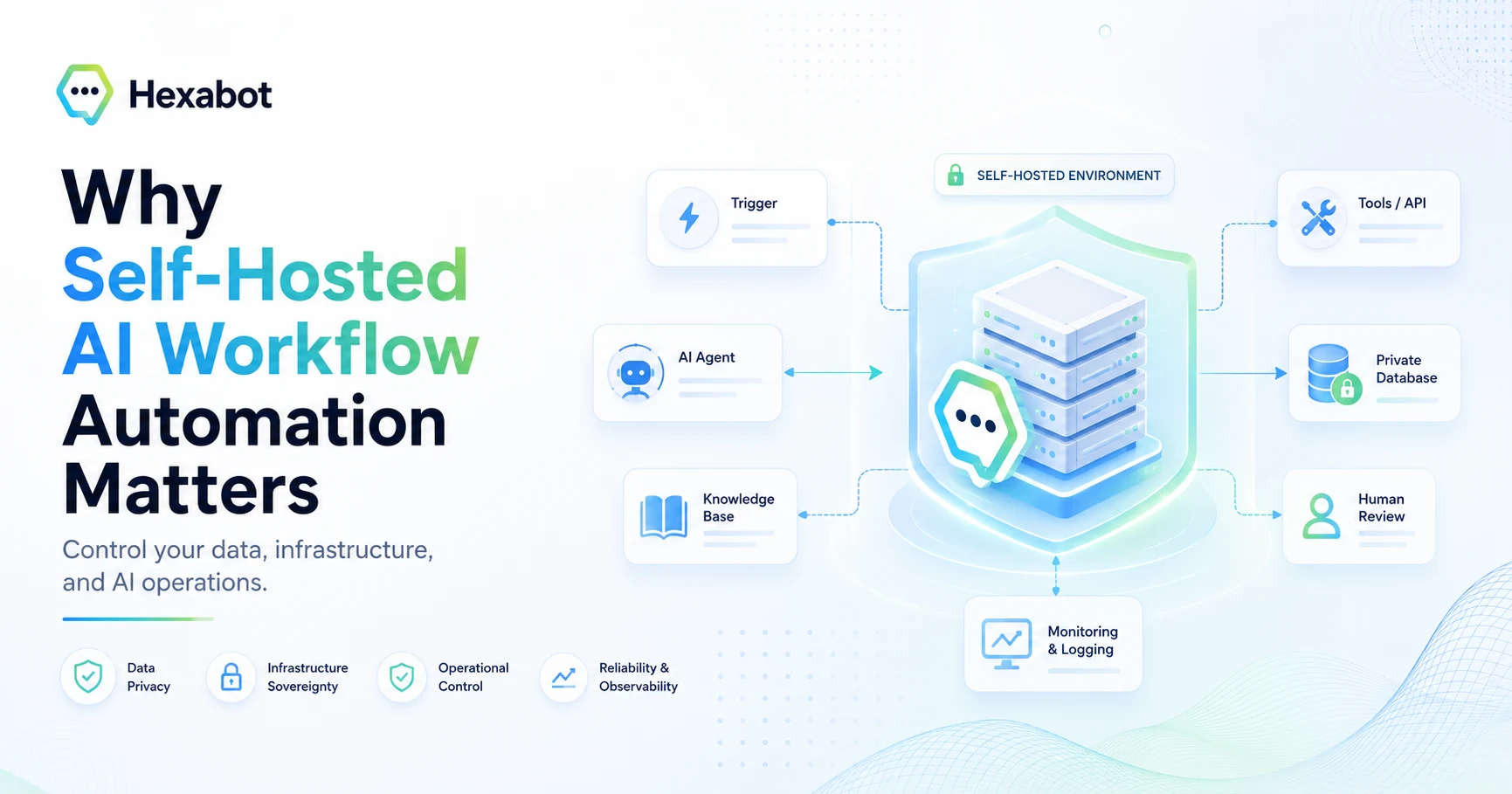
AI workflow automation is quickly becoming one of the most important layers of modern business software.
Teams no longer want simple scripts that move data from one app to another. They want AI systems that can understand context, trigger actions, use tools, search knowledge, route conversations, escalate to humans, and adapt to changing business processes.
That shift is powerful. But it also creates a new question:
Where should your AI automation actually run?
For many organizations, the default answer has been cloud-based SaaS. It is easy to start, fast to test, and usually requires little infrastructure knowledge. But as AI workflows become more deeply connected to customer conversations, internal operations, private data, and business-critical processes, self-hosting becomes much more than a deployment preference.
It becomes a strategic choice.
Self-hosted AI workflow automation gives teams more control over data, security, compliance, customization, reliability, and long-term independence. For companies that want to use AI seriously in production, that control matters.
What Is Self-Hosted AI Workflow Automation?
Self-hosted AI workflow automation means running your automation platform on infrastructure you control.
That infrastructure can be a private cloud, a virtual server, an on-premise environment, or a managed environment operated by your technical team. The important point is that the automation engine, data flows, integrations, logs, and configuration are not locked inside a third-party SaaS platform.
In the context of AI, this becomes especially important because workflows are no longer just moving records between tools. They may process support conversations, analyze internal documents, trigger operational tasks, connect to CRMs, call APIs, search knowledge bases, and use language models to make decisions.
A traditional workflow might say:
“When a form is submitted, send an email.”
An AI workflow can say:
“Read the customer request, identify the intent, check the customer profile, search the knowledge base, decide whether the issue can be solved automatically, generate a response, trigger an internal action if needed, and escalate to a human if confidence is low.”
That is a very different level of responsibility.
When workflows become intelligent, contextual, and action-oriented, the environment where they run becomes part of the trust model.
AI Automation Is Moving Closer to Core Business Operations
In the early days of automation, most workflows were peripheral. They synchronized leads, copied files, sent notifications, or created tickets.
Today, AI automation is moving closer to the center of business operations.
Companies are using AI workflows for customer support, sales qualification, document processing, internal knowledge access, IT support, onboarding, compliance workflows, and operational decision support.
This means AI systems may interact with sensitive business data, customer identities, contracts, invoices, support histories, internal procedures, and proprietary knowledge.
The more valuable the workflow, the more sensitive the context usually becomes.
That is why self-hosting matters. It gives organizations the ability to decide how data moves, where it is stored, which systems can access it, and how the automation layer fits into existing security and governance policies.
AI workflow automation is not only about productivity. It is about operational control.
Data Control Is the First Reason Self-Hosting Matters
AI workflows often need context to be useful.
They may need to read messages, retrieve user profiles, search documents, inspect previous interactions, or connect to business systems. Without context, AI automation becomes generic. With context, it becomes useful.
But context is also where risk begins.
A cloud automation platform may require data to pass through external infrastructure. That may be acceptable for some use cases, but not for all. Organizations working with regulated industries, enterprise clients, private customer data, or confidential internal knowledge often need stronger guarantees.
Self-hosted automation allows teams to keep more control over:
-
where workflow data is processed
-
where logs and execution history are stored
-
which databases are used
-
which APIs are allowed
-
which models are connected
-
which data leaves the environment
This does not automatically solve every privacy or compliance challenge. But it gives technical and security teams the foundation they need to design the right architecture.
For AI workflows, data control is not a nice-to-have. It is one of the conditions for trust.
Compliance Needs More Than a Checkbox
Many companies are under pressure to adopt AI while also respecting compliance requirements, privacy policies, customer contracts, and internal governance rules.
This is especially true for teams serving enterprise customers or operating in sectors such as finance, healthcare, telecom, government, insurance, legal services, and education.
A common mistake is to treat AI automation as a simple productivity tool. In reality, AI workflows can become part of the organization’s decision-making and communication infrastructure.
That means companies need to answer practical questions:
Where is customer data processed? Who can access workflow logs? Can we audit what happened? Can we explain why a workflow made a decision? Can we restrict certain tools or actions? Can we separate environments for development, testing, and production? Can we choose which AI providers or models are used?
Self-hosted AI workflow automation makes these questions easier to address because the organization has more control over the system design.
It does not replace legal, security, or compliance work. But it gives teams the technical flexibility to implement policies instead of being forced to adapt to the limitations of a closed platform.
Security Requires Control Over the Automation Layer
AI workflows are powerful because they connect systems together.
That is also why they must be secured carefully.
A workflow automation platform may have access to APIs, databases, messaging channels, CRMs, ticketing systems, internal tools, and knowledge bases. If the platform becomes deeply integrated into operations, it becomes a critical part of the security perimeter.
With a self-hosted platform, teams can align the automation layer with their own security practices.
They can manage network access, apply internal authentication rules, control secrets, restrict outbound connections, configure database policies, monitor logs, and deploy inside trusted infrastructure.
This level of control is difficult to achieve when the automation platform is entirely managed outside the organization.
The goal is not to say that cloud platforms are always insecure. Many SaaS providers invest heavily in security. The point is that security requirements vary by organization, and some teams need direct control over deployment, access, storage, and integration boundaries.
For business-critical AI automation, that control can be decisive.
Self-Hosting Reduces Vendor Lock-In
AI automation platforms are becoming the new operational layer between people, software, and AI models.
Once a company builds dozens of workflows on a platform, switching becomes difficult. The workflows contain business logic, integrations, prompts, conditions, routing rules, and operational knowledge.
If that logic is locked inside a closed platform, the company may become dependent on one vendor’s pricing, roadmap, uptime, limitations, and export options.
Self-hosting helps reduce that dependency.
When teams can run the platform themselves, inspect how workflows are structured, control the runtime, and integrate it into their own stack, they gain more long-term independence.
This matters even more in AI because the ecosystem changes quickly. New models appear. Regulations evolve. Infrastructure costs fluctuate. Business needs shift.
A flexible, self-hosted automation layer allows companies to adapt without rebuilding everything from scratch.
Customization Is Essential for Real Business Automation
No two businesses operate exactly the same way.
A support workflow for a telecom company is different from a workflow for a SaaS company. A sales qualification process in B2B is different from a public-sector service request. A chatbot for customer support is different from an internal AI assistant connected to company knowledge.
Generic automation tools are useful for common tasks. But real business automation often requires custom logic, custom integrations, custom channels, custom permissions, and custom deployment constraints.
Self-hosted AI workflow automation gives technical teams the freedom to extend the platform around the business.
That can include connecting private APIs, building plugins, integrating with internal systems, adding custom business rules, controlling the user interface, or adapting workflows to local operational needs.
This is where platforms like Hexabot are especially relevant.
Hexabot is designed for teams that want the flexibility of AI agents and workflow automation while keeping control over deployment, data, and extensibility. Business teams can design and improve workflows visually, while technical teams can extend the platform with plugins, integrations, channels, and business-specific logic.
That balance matters because many organizations do not want a rigid no-code tool, but they also do not want to build an AI automation platform from scratch.
AI Workflows Need Reliability, Not Just Intelligence
The AI industry often focuses on model intelligence. But in production, intelligence is not enough.
A business workflow must be reliable.
It needs clear triggers, predictable execution, error handling, observability, human escalation, and guardrails. It should be possible to understand what happened when something goes wrong.
This is especially important with AI agents.
An AI agent may reason, call tools, retrieve knowledge, and decide what to do next. That makes it more flexible than a traditional automation. But it also means teams need more structure around how the agent operates.
A self-hosted workflow automation platform can give teams the ability to design that structure.
Instead of letting AI behave like a black box, teams can build workflows that combine AI reasoning with explicit steps, conditions, approvals, tool restrictions, and fallback paths.
For example, a customer support workflow can allow AI to answer simple questions automatically, but require human handoff when confidence is low, when the request involves billing, or when the customer expresses frustration.
That is the right way to think about production AI automation: autonomy where it helps, control where it matters.
Human Oversight Still Matters
A common assumption is that the goal of AI automation is to remove humans completely.
In reality, the best AI workflows often keep humans in the loop for important moments.
Human oversight is useful when decisions are sensitive, data is incomplete, confidence is low, or the customer experience requires empathy and judgment.
Self-hosted AI workflow automation makes it easier to design human oversight according to the company’s own rules.
A team can decide when to escalate, who receives the task, what context is shown, how approvals work, and how the final decision is logged.
This is especially important in customer-facing automation. A chatbot or AI agent should not be judged only by how many conversations it handles automatically. It should also be judged by how safely and smoothly it knows when not to automate.
The best AI systems do not replace human judgment everywhere. They make human judgment more focused, timely, and effective.
Cost Predictability Becomes Important at Scale
Cloud automation platforms are attractive because they are easy to start with. But pricing can become harder to predict as usage grows.
AI workflows may involve many executions, messages, API calls, model requests, document searches, and team members. As automation becomes more successful, usage increases.
That is a good problem to have, but it can also create budget uncertainty.
Self-hosting gives teams more control over infrastructure and scaling costs. Organizations can choose their hosting provider, optimize resources, separate environments, use preferred databases, and decide which AI models are worth using for each workflow.
Some workflows may need advanced models. Others may work well with smaller models, local inference, rule-based steps, or retrieval-based responses.
A self-hosted architecture gives teams more room to optimize these decisions.
Cost control is not only about paying less. It is about understanding what you are paying for and being able to adapt the architecture as the system grows.
Self-Hosted Does Not Mean Isolated
Self-hosted AI workflow automation does not mean disconnected from the modern AI ecosystem.
A self-hosted platform can still connect to external APIs, cloud models, open-source models, internal databases, messaging channels, CRMs, and business applications.
The difference is that the organization controls the orchestration layer.
This means teams can decide which services to connect, which data to send, which workflows should use external models, and which workflows should stay fully private.
That flexibility is important because most companies will not use one AI model, one tool, or one deployment pattern forever.
Some use cases may require cloud LLMs. Others may require private models. Some workflows may run on internal infrastructure. Others may integrate with external services.
Self-hosting gives companies the ability to choose the right architecture for each use case instead of forcing every workflow through the same SaaS model.
Why This Matters for AI Agents
AI agents are becoming one of the most discussed areas of automation.
An AI agent can plan, use tools, retrieve context, interact with users, and take actions across systems. But the more capable an agent becomes, the more important governance becomes.
A self-hosted AI workflow automation platform can help teams build agents that are not just powerful, but manageable.
Instead of giving an AI agent unlimited freedom, teams can define the workflow around it:
What tools can it use? What data can it access? When should it ask for confirmation? When should it escalate? What should be logged? Which actions are allowed automatically? Which actions require approval?
This is the difference between experimenting with AI agents and running AI agents in production.
Businesses do not only need autonomous systems. They need controlled autonomy.
The Future of AI Automation Is Controlled, Extensible, and Self-Hostable
AI workflow automation will continue to evolve quickly.
More workflows will include AI reasoning. More business systems will expose APIs. More teams will expect automation to understand context and take action. More organizations will demand privacy, explainability, and control.
This creates a clear direction for the next generation of automation platforms.
They need to be visual enough for business teams, extensible enough for developers, reliable enough for production, and controllable enough for organizations that take data seriously.
Self-hosting is a key part of that future.
It gives teams the freedom to build AI workflows around their own infrastructure, security model, business logic, and operational needs.
For small teams, it means independence and flexibility. For enterprises, it means governance and control. For developers, it means extensibility. For business teams, it means automation that can actually match how the organization works.
How Hexabot Approaches Self-Hosted AI Workflow Automation
Hexabot is built for teams that want to create AI agents, conversational automation, and business workflows while keeping control over their platform.
It combines visual workflow design with developer extensibility, allowing business and technical teams to collaborate on automation without being locked into a rigid black box.
With Hexabot, teams can build workflows for customer support, internal operations, multichannel conversations, knowledge-based assistance, tool usage, and human handoff.
The goal is not only to automate tasks. The goal is to help organizations build reliable AI systems that can run in real business environments.
Self-hosted AI workflow automation matters because AI is becoming part of the operational core of companies.
And when AI becomes operational, control matters.
Conclusion
AI workflow automation is no longer just about saving time.
It is about how companies connect people, data, software, and intelligent systems.
As AI workflows become more powerful, organizations need to think carefully about where those workflows run, who controls them, how data is handled, and how decisions are governed.
Cloud tools will continue to be useful for many use cases. But for teams that care about data control, customization, compliance, security, and long-term independence, self-hosted AI workflow automation offers a stronger foundation.
The future of AI automation will not be defined only by smarter models.
It will be defined by the platforms that help teams use AI safely, reliably, and under their control.
That is why self-hosted AI workflow automation matters.