From Chatbot to AI Agent: How Conversational Automation Is Evolving
Conversational automation is evolving from traditional chatbots to AI agents that understand context, use tools and automate business processes.

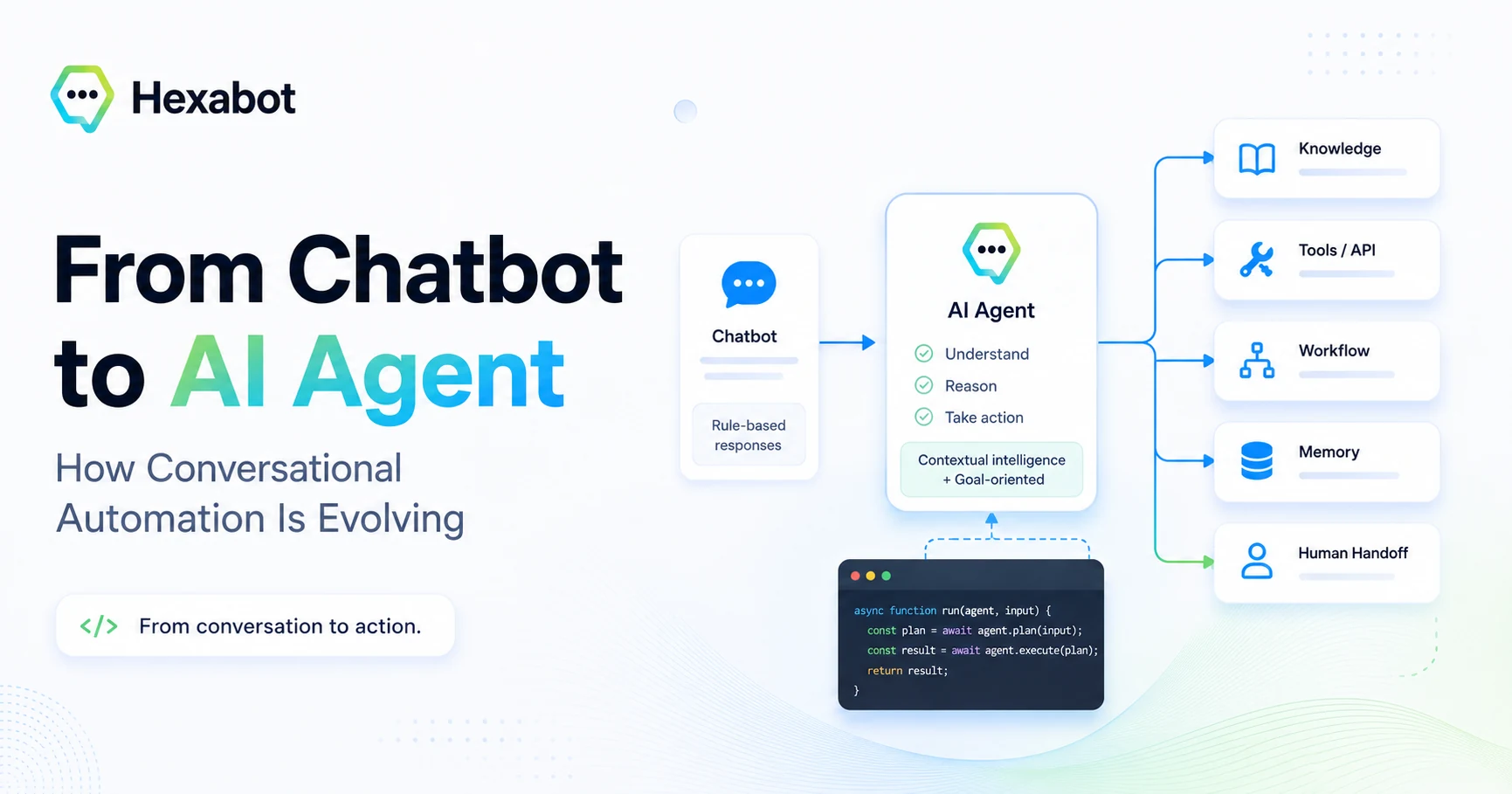
For many years, the word chatbot was associated with simple customer support widgets, scripted conversations, FAQ assistants, and menu-based flows.
A user asked a question. The bot matched an intent. The bot returned a predefined answer.
That model was useful, and it still is in many situations. But conversational automation is now moving into a much more ambitious phase.
Today, businesses do not only want bots that answer questions. They want systems that can understand a request, retrieve information, make decisions, interact with tools, trigger workflows, and involve humans when needed.
This is where the conversation shifts from chatbots to AI agents.
But the evolution is not simply about replacing old bots with large language models. It is about rethinking conversational automation as a complete system: language understanding, business logic, workflow orchestration, integrations, memory, governance, observability, and human handoff.
In other words, the future of conversational automation is not just “a smarter chatbot.” It is a new layer of business automation powered by conversation.
What Traditional Chatbots Were Designed to Do
Traditional chatbots were mostly designed to automate repetitive interactions.
They were especially useful for:
-
Answering frequently asked questions
-
Collecting user information
-
Routing requests to the right department
-
Helping users navigate services
-
Automating simple support flows
-
Providing 24/7 first-level assistance
Many of these chatbots relied on rules, decision trees, or intent classification.
For example, a telecom chatbot might detect that the user wants to check their internet bill. Once the intent is identified, the chatbot follows a predefined path: ask for the customer ID, verify the account, retrieve billing data, and show the answer.
This approach has clear advantages. It is predictable, controlled, easy to test, and relatively safe for business-critical use cases.
But it also has limits.
Traditional chatbots often struggle when the user says something unexpected, changes topic, provides incomplete information, or asks for something outside the predefined flow. They can feel rigid because they do not truly reason about the task. They mostly follow paths that were designed in advance.
That is why many early chatbot experiences became frustrating. Users quickly realized they were not really talking to an intelligent system. They were interacting with a narrow automation interface.
The LLM Shift: From Intent Detection to Language Understanding
Large language models changed the expectations around conversational interfaces.
Instead of only matching user messages to predefined intents, LLM-powered systems can understand natural language in a much more flexible way. They can interpret messy input, summarize information, extract entities, generate responses, translate content, classify requests, and explain complex topics.
This changed the role of the chatbot.
A conversational system no longer has to depend entirely on rigid buttons or perfectly phrased commands. A user can write:
“I received my package but one item is missing, and I want to know what to do next.”
A traditional chatbot might need a predefined intent such as missing_item_order_issue.
An LLM-powered assistant can understand the broader meaning: the user has a post-purchase issue, probably needs order verification, may need a refund or replacement process, and should be guided through the next steps.
This is a major improvement. But language understanding alone is not enough.
A system that only understands and replies is still mostly an assistant. To become truly useful in business operations, it must be able to act.
What Makes an AI Agent Different from a Chatbot?
An AI agent is not just a chatbot with better text generation.
An AI agent is a system that can use reasoning, context, tools, and workflows to pursue a goal.
A chatbot usually focuses on conversation. An AI agent focuses on task completion.
For example, imagine a customer asks:
“Can you help me upgrade my subscription and send the invoice to my finance team?”
A basic chatbot might explain how to do it.
A more advanced assistant might generate a helpful answer with instructions.
An AI agent could potentially:
-
Understand the user’s request
-
Check the current subscription
-
Validate whether the user is authorized
-
Present available upgrade options
-
Confirm the selected plan
-
Update the subscription in the billing system
-
Generate or retrieve the invoice
-
Send it to the finance contact
-
Create an internal activity log
-
Notify a human team if something fails
That is the real difference.
The value is not only in the conversation. The value is in connecting the conversation to actual business execution.
Conversational Automation Is Becoming Workflow Automation
The most important shift is that conversational automation is no longer limited to chat.
It is becoming a front door to business workflows.
The user expresses a need in natural language. Behind the scenes, the system transforms that need into structured actions.
This can apply to many use cases:
-
Customer support ticket creation
-
Lead qualification
-
Appointment scheduling
-
Refund processing
-
Internal IT support
-
HR onboarding
-
Knowledge base search
-
CRM updates
-
Order tracking
-
Report generation
-
Incident escalation
-
Document processing
In the old model, the chatbot was often a separate interface sitting on top of business systems.
In the new model, the AI agent becomes part of the operational layer. It can interact with APIs, databases, internal tools, documents, and human teams.
This is why the concept of AI workflow automation is becoming so important. The future is not only about having a conversational interface. It is about designing reliable workflows where AI plays the right role at the right moment.
Why AI Agents Still Need Structure
There is a common misconception that AI agents should be fully autonomous and decide everything by themselves.
That sounds powerful, but in production environments it can quickly become risky, expensive, and difficult to control.
Businesses need more than “let the AI figure it out.”
They need systems that can define:
-
What the agent is allowed to do
-
Which tools it can use
-
When it should ask for confirmation
-
When it should escalate to a human
-
Which steps must be deterministic
-
Which steps can use AI reasoning
-
How errors should be handled
-
How every action should be logged and monitored
This is where structured workflows become essential.
A production-ready AI agent should not be a black box. It should operate inside a clear framework, with defined steps, permissions, conditions, and fallback mechanisms.
For example, generating a friendly response can be handled by an LLM. But updating a customer subscription, issuing a refund, deleting data, or escalating an incident should follow controlled business rules.
The best AI automation systems combine two things:
AI flexibility for understanding and reasoning. Workflow structure for reliability and control.
That combination is what makes conversational automation useful beyond demos.
The New Architecture of Conversational Automation
Modern conversational automation usually includes several layers working together.
At the surface, there is the conversation interface: web chat, WhatsApp, Messenger, Slack, email, voice, or another channel.
Behind that interface, there is a language understanding layer. This may include LLMs, classifiers, entity extraction, translation, sentiment analysis, or retrieval from a knowledge base.
Then comes the orchestration layer. This is where the system decides what should happen next. Should it answer directly? Ask a question? Call an API? Trigger a workflow? Escalate to a human?
Finally, there is the integration layer. This connects the agent to business systems such as CRMs, ERPs, ticketing platforms, calendars, databases, payment systems, analytics tools, or internal APIs.
A simplified architecture looks like this:
User message
   ↓
Conversation channel
   ↓
AI understanding and context analysis
   ↓
Workflow orchestration
   ↓
Tools, APIs, knowledge bases, and business systems
   ↓
Response, action, or human handoff
This architecture shows why the chatbot is only one visible part of the system.
The real value is in what happens behind the conversation.
From Reactive Bots to Proactive Agents
Traditional chatbots are mostly reactive. They wait for the user to ask something.
AI agents can be more proactive.
For example, an agent could detect that a support ticket has been open for too long and notify a manager. It could identify a high-value lead and trigger a follow-up workflow. It could monitor failed payments and start a recovery sequence. It could summarize unresolved conversations and recommend next actions to a support team.
This expands conversational automation from customer-facing chat to internal operations.
The agent is no longer only responding to messages. It can become part of a larger business process.
That said, proactivity must be designed carefully. Nobody wants an AI system that takes uncontrolled actions or overwhelms teams with unnecessary notifications. Proactive agents should operate with clear triggers, priorities, and approval rules.
Again, the future is not uncontrolled autonomy. It is controlled automation with intelligent assistance.
Human Handoff Is Still Essential
As AI agents become more capable, it may be tempting to imagine that they will replace human operators entirely.
In reality, the most effective systems often combine AI automation with human expertise.
There will always be cases where a human should step in:
-
Sensitive customer complaints
-
Complex negotiations
-
Unclear or conflicting information
-
High-risk operations
-
Legal or compliance-related questions
-
Emotional or urgent situations
-
Requests that fall outside policy
A good AI agent should know when not to continue alone.
Human handoff should not be treated as failure. It is part of a mature automation strategy.
The agent can still add value before escalation by collecting information, summarizing the conversation, identifying the issue, suggesting next steps, and sending the case to the right person.
This reduces repetitive work while keeping humans involved where judgment, empathy, or authority is needed.
The Role of Knowledge in AI Agents
One of the biggest improvements in conversational automation is the ability to connect AI systems to knowledge sources.
Instead of relying only on what the model already knows, an AI agent can retrieve information from company documents, help centers, product manuals, policies, internal wikis, support tickets, or databases.
This is often called retrieval-augmented generation, or RAG.
For example, a support agent can answer questions based on the latest product documentation. An HR assistant can respond using internal policies. A technical assistant can search developer docs before generating an answer.
This makes AI agents more useful and more specific to the business.
However, knowledge retrieval must also be managed carefully. The system needs good content structure, source control, access permissions, and quality checks. Otherwise, the AI may retrieve outdated, irrelevant, or incomplete information.
Good AI automation is not only about the model. It is also about the quality of the connected knowledge.
Why Developers Matter More Than Ever
The rise of AI agents does not eliminate the need for developers. It increases the importance of good engineering.
Building a demo chatbot is easy. Building a reliable AI automation system is much harder.
Developers need to think about:
-
API integrations
-
Authentication and permissions
-
Data validation
-
Error handling
-
Rate limits
-
Observability
-
Testing
-
Workflow versioning
-
Cost control
-
Security
-
Deployment
-
Human review processes
This is why developer-friendly AI automation platforms are becoming important.
Teams need tools that allow them to combine natural language capabilities with real software engineering practices. They need to define workflows, create reusable actions, connect services, test behavior, and monitor execution.
The agent is not magic. It is software.
And like any serious software system, it needs architecture.
Chatbots Are Not Dead
It would be a mistake to say that chatbots are obsolete.
In many cases, a simple chatbot is still the right solution.
A structured chatbot can be better than an AI agent when the use case is narrow, predictable, regulated, or repetitive. For example, checking order status, collecting contact information, booking appointments, or answering basic FAQs may not require complex reasoning.
The goal is not to replace every chatbot with an autonomous agent.
The goal is to choose the right level of intelligence and automation for the task.
A mature conversational automation strategy may include:
-
Simple scripted flows for predictable tasks
-
AI-assisted responses for flexible conversations
-
Knowledge retrieval for document-based answers
-
Workflow automation for business processes
-
Human handoff for complex or sensitive cases
-
AI agents for goal-oriented multi-step tasks
The evolution from chatbot to AI agent is not a binary switch. It is a spectrum.
What Businesses Should Look for in AI Agent Platforms
As conversational automation evolves, businesses should look beyond the quality of generated responses.
A strong AI agent platform should help teams design, control, and improve automation over time.
Important capabilities include:
-
Multi-channel conversation support
-
Workflow orchestration
-
Tool and API integration
-
Knowledge base connection
-
Human handoff
-
Memory and context management
-
Role-based access control
-
Logging and analytics
-
Testing and debugging tools
-
Deployment flexibility
-
Cost control options
-
Support for both deterministic logic and AI reasoning
The best platforms will not force teams to choose between rigid workflows and flexible AI. They will allow both to work together.
That is where the real value of AI agents will appear: not in replacing structure, but in making structured automation more intelligent and easier to use.
The Future: Conversation as a Business Interface
The evolution from chatbot to AI agent points toward a larger transformation.
Conversation is becoming a universal interface for software.
Instead of asking users to navigate complex dashboards, forms, and menus, businesses can let users express what they need naturally. The system can then translate that request into the right workflow.
This does not mean traditional interfaces will disappear. Dashboards, forms, and admin panels will still matter.
But conversation will increasingly become the easiest way to start, guide, and complete tasks.
A customer might say, “I want to change my delivery address.” An employee might say, “Create a report for last month’s sales.” A manager might say, “Show me unresolved high-priority tickets and summarize the risks.” A developer might say, “Trigger the onboarding workflow for this new client.”
Behind each request, an AI agent can coordinate the right tools and workflows.
That is the real promise of conversational automation.
Not just better chat. Better work.
Conclusion
The journey from chatbot to AI agent is not only a technological upgrade. It is a shift in how businesses think about automation.
Traditional chatbots helped companies automate conversations. AI agents help them automate outcomes.
But the most effective systems will not be purely autonomous or purely scripted. They will combine the flexibility of AI with the reliability of workflows, integrations, permissions, monitoring, and human oversight.
As conversational automation continues to evolve, the winning approach will be clear: use AI where it adds intelligence, use workflows where structure is needed, and keep humans involved where judgment matters.
The future of AI agents is not about removing control. It is about building smarter systems that can understand, act, and collaborate safely.
Build Conversational AI Workflows with Hexabot
Hexabot is a self-hosted AI chatbot and workflow automation platform designed to help teams move from simple conversational bots to more advanced AI-powered automation. With support for workflows, actions, channels, AI integrations, and developer-friendly extensibility, Hexabot gives builders a structured way to create conversational experiences that can connect to real business processes while remaining flexible, observable, and controllable.