Hexabot vs n8n for AI Workflow Automation: Which One Should You Use?
Compare Hexabot and n8n for AI automation, agentic workflows, chatbots, integrations, self-hosting, memory, extensibility, and production use cases.

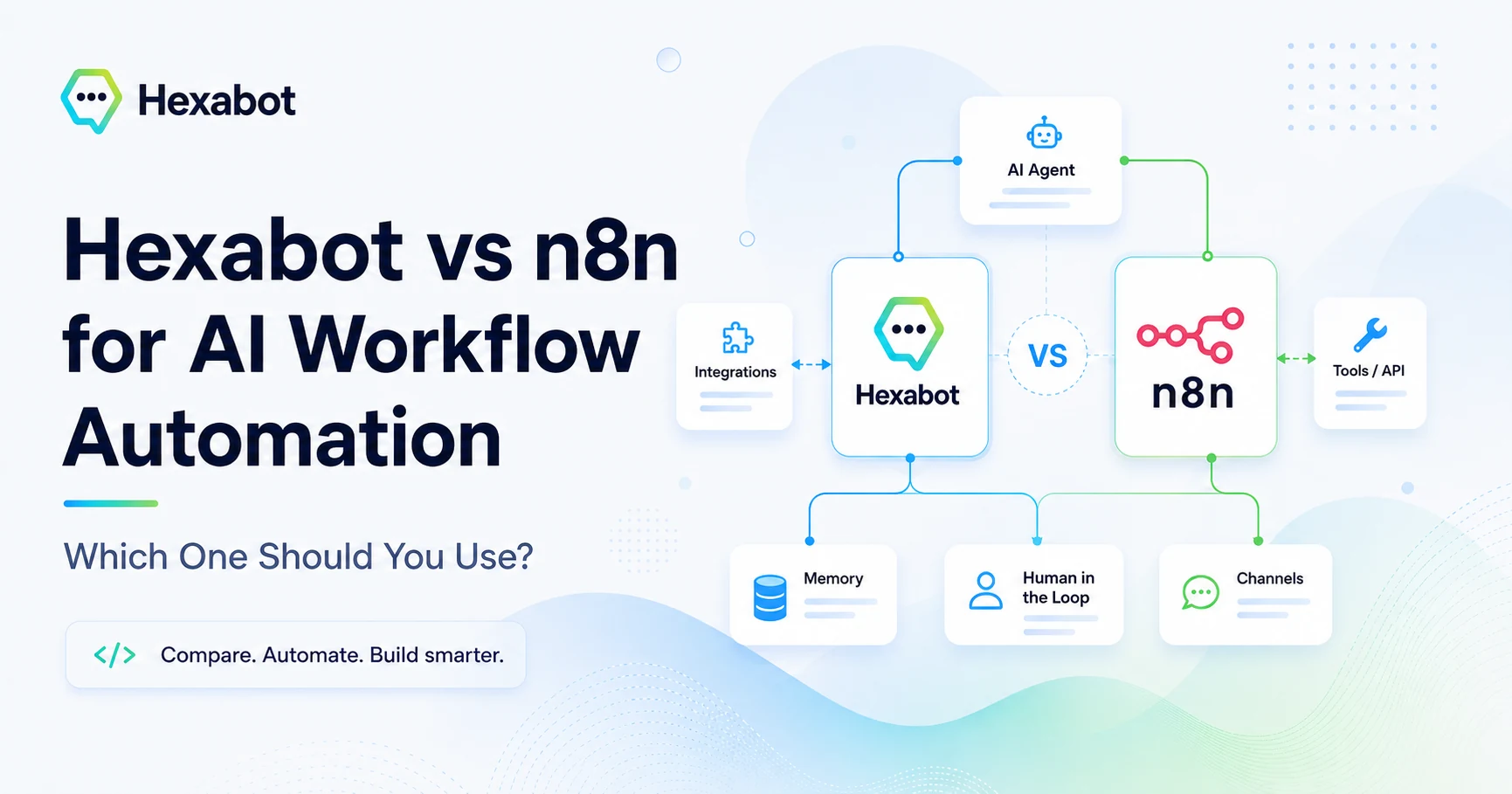
AI workflow automation is becoming a new operating layer for modern software teams. Companies no longer want simple chatbots, isolated scripts, or one-off SaaS automations. They want systems that can understand intent, retrieve knowledge, call tools, follow business rules, involve humans when needed, and execute reliably in production.
This is where platforms like Hexabot and n8n enter the conversation.
Both can be used to build AI-powered workflows. Both can be self-hosted. Both are developer-friendly compared to purely closed SaaS automation tools. But they are designed around different priorities.
n8n is a general workflow automation platform that combines business process automation with AI capabilities. Its own documentation describes it as a fair-code workflow automation tool that combines AI capabilities with business process automation. (n8n Docs)
Hexabot is a self-hostable AI workflow automation platform built around agentic workflows, actions, conversational channels, memory, RAG, MCP, and extensibility. The Hexabot v3 repository describes it as a platform for building and running agentic workflows across channels with YAML, tools, MCP, memory, and RAG. (GitHub)
So, which one should you use?
The answer depends on whether your main problem is general workflow automation with AI steps or AI-native conversational workflow automation.
What is n8n?
n8n is a workflow automation platform designed to connect applications, APIs, databases, AI models, and internal systems through visual workflows.
It is often used for automations such as:
- Syncing data between CRMs, databases, spreadsheets, and internal tools
- Triggering actions from webhooks, schedules, forms, or app events
- Building internal business process automations
- Adding AI steps to existing workflows
- Creating AI agents that can use tools and APIs
n8n has strong AI capabilities. Its AI Agent node is described as an autonomous system that receives data, makes decisions, and uses external tools and APIs to perform actions or retrieve information. The documentation also states that an AI Agent node must be connected to at least one tool sub-node. (n8n Docs)
This makes n8n a good fit when AI is one part of a larger automation system.
What is Hexabot?
Hexabot is an AI workflow automation platform focused on building AI agents, workflows, and conversational automations that can run across channels.
Hexabot provides features such as a visual editor, AI-powered interactions, multichannel communication, a knowledge base, multilingual support, live chat and agent takeover, user and role management, plugins, and analytics. (Hexabot)
With Hexabot v3, the platform moves beyond the traditional chatbot-builder model. It combines workflows, actions, agents, and conversational channels in one runtime. Its core capabilities include YAML workflow definitions, schema-validated actions, memory support, MCP integration points, multi-channel continuity, and Zod-based validation. (GitHub)
This makes Hexabot especially relevant when the workflow is not only a background automation, but a live AI-driven interaction with users.
The core difference: workflow automation vs AI-native automation
The simplest way to compare the two platforms is this:
Use n8n when your main problem is connecting tools and automating business processes. Use Hexabot when your main problem is building AI agents and workflows that interact with users, preserve context, use memory, call tools, and operate across channels.
n8n starts from a broad automation perspective. You create visual workflows, connect nodes, transform data, and add AI where needed.
Hexabot starts from an AI automation and conversational runtime perspective. You define workflows, actions, memory, channels, and agent behavior as core parts of the platform.
That distinction matters because production AI is not just about sending prompts to a model. Production AI needs structure, observability, reusable capabilities, permissions, state, human handoff, and predictable execution.
Hexabot vs n8n: comparison table
| Criteria | Hexabot | n8n |
|---|---|---|
| Primary focus | AI workflow automation, agentic workflows, conversational channels, memory, RAG, MCP | General workflow automation, app integrations, business process automation, AI nodes |
| Best for | AI agents, support automation, conversational workflows, workflow-driven chatbots, human handoff | Internal automations, SaaS integrations, data sync, scheduled workflows, API orchestration |
| Workflow model | YAML-based agentic workflows, typed contracts, reusable actions | Visual node-based workflows with triggers, actions, AI nodes, and integrations |
| AI model | AI is part of the workflow runtime and conversational architecture | AI is added through AI nodes, agents, tools, and LangChain-related components |
| Conversational use cases | Core focus: channels, chat workflows, context, inbox, human takeover | Possible through Chat Trigger, AI Agent, workflow tools, and chatbot-style flows |
| Custom logic | Custom actions are developed as reusable workflow steps with schemas and executable code | Code can be added directly in the UI using Code nodes or Custom Code Tool nodes |
| Testing and governance | Actions live in code and can be type-checked, linted, unit tested, reviewed, and versioned | Code nodes are fast and flexible; custom nodes can also be developed and tested separately |
| Pricing model | Public pricing is capacity-oriented, with limits such as activations, users, and workflows | Paid plans are based on monthly workflow executions, with unlimited workflows and users |
| Self-hosting | Self-hostable AI workflow automation platform | Free and paid self-hosted options, plus n8n Cloud |
| Commercial license nuance | Fair Core License with competing-use restrictions before the future Apache-2.0 license date | Sustainable Use License allows internal business use but restricts resale, hosting, and white-labeling where value derives substantially from n8n |
Where n8n shines
n8n is very strong when your automation starts with systems integration.
For example, n8n is a natural fit when you want to:
- Send a Slack notification when a CRM deal changes
- Enrich new leads using an external API
- Move data between Google Sheets, Airtable, HubSpot, Notion, or internal databases
- Run scheduled workflows
- Add an AI summarization or classification step inside a larger process
- Build an AI agent that can call external tools
n8n’s AI tools are also flexible. Its documentation explains that AI agents can use tool sub-nodes such as the Call n8n Workflow Tool, Custom Code Tool, and HTTP Request Tool. (n8n Docs)
This means n8n works well when the AI agent is one part of a larger automation graph.
The platform also makes quick customization easy. The Code node lets users write JavaScript or Python and run it as a step inside the workflow. (n8n Docs)
That is a major advantage for teams that want to move fast, prototype quickly, and add custom transformations without creating a full extension or package.
Where Hexabot shines
Hexabot is strongest when the automation is centered around an AI-driven user interaction.
For example, Hexabot is a strong fit when you want to build:
- A customer support AI agent that understands intent, retrieves knowledge, asks follow-up questions, and escalates to a human
- A sales assistant that qualifies leads through conversation before sending structured data to a CRM
- A workflow that starts from a chat message, uses memory, calls tools, and continues across channels
- A self-hosted AI automation system where actions, workflows, and channels are controlled by developers
- A production-oriented agentic workflow runtime where custom capabilities are reusable and testable
Hexabot’s architecture is especially relevant for conversational AI because it includes features like multichannel communication, knowledge base, live chat, agent takeover, user segmentation, roles, plugins, and analytics. (Hexabot)
In Hexabot v3, workflows are not just visual diagrams. The agentic package provides a typed runtime and YAML DSL for orchestrating multi-step AI and automation workflows. It supports JSONata expressions, schema validation, resumable execution, human-in-the-loop pauses, sequential and parallel flow primitives, conditionals, loops, and observability hooks. (GitHub)
For production AI, this matters. You need to know what the AI is allowed to do, what tools it can call, what memory it can access, how workflows resume, how errors are handled, and how behavior can be tested.
Pricing and licensing: an important nuance
This is one of the areas where the comparison needs to be precise.
It would not be accurate to simply say that “n8n is not free for commercial use.” n8n offers a free self-hosted Community Edition, and its documentation states that self-hosted users have both free and paid options. (n8n Docs)
The more accurate point is that n8n’s Sustainable Use License allows internal business use, but restricts certain commercial use cases. The license allows use, modification, derivative works, and redistribution with limitations, including that use or modification must be for internal business purposes or non-commercial/personal use. n8n’s docs also say that white-labeling n8n for paying customers or hosting n8n and charging people to access it would not be allowed under that license. (n8n Docs)
n8n also has a separate OEM model. Its documentation says that embedding and surfacing the n8n interface inside another product’s UI requires a separate commercial OEM agreement. (n8n Docs)
So the correct takeaway is:
n8n can be free for internal self-hosted business use, but it is commercially restricted if you want to resell, white-label, host, or embed n8n as part of a product where n8n’s functionality is a substantial part of the value.
Pricing is another key difference.
n8n’s paid pricing page says that all plans include unlimited users, unlimited workflows, and every integration, while pricing is based on monthly workflow executions regardless of complexity. (n8n)
Hexabot’s public pricing, on the other hand, is presented around capacity limits such as activations, users, and workflows, rather than per-execution billing. (hexabot.ai)
This gives Hexabot a different positioning for teams that want predictable self-hosted AI automation costs, especially when workflows may run frequently.
Custom logic: UI code vs reusable actions
Another important difference is how both platforms handle custom workflow behavior.
n8n makes it easy to add custom logic directly inside the workflow. The Code node lets you write JavaScript or Python as a workflow step. (n8n Docs)
For AI agents, n8n also provides a Custom Code Tool node, which lets you write code that an agent can run. The node supports JavaScript and Python. (n8n Docs)
This is very practical for quick scripts, data transformations, API formatting, or custom agent tools that need to be created directly from the UI.
Hexabot takes a more engineering-driven approach. Custom workflow capabilities are implemented as actions. The Hexabot documentation describes custom actions as reusable workflow steps with Zod schemas, metadata, and an execute function. (Hexabot)
This means Hexabot custom actions require development work. But the benefit is that they become reusable, versioned, reviewable, and testable pieces of production code.
The Hexabot custom action packaging guide also covers how to package, test, publish, and install reusable hexabot-action-* npm packages. (Hexabot)
This difference reflects two different philosophies:
n8n optimizes for speed and low-code flexibility. Hexabot optimizes for reusable, governed, production-grade workflow capabilities.
To be fair, n8n also supports developer-built custom nodes, and its documentation includes testing guidance and a node linter for custom node development. (n8n Docs)
The distinction is not that n8n cannot be extended properly. It can. The distinction is that n8n gives users a very convenient inline-code path from the UI, while Hexabot pushes custom workflow steps toward a more structured software engineering model.
AI agents: node-based vs runtime-based thinking
Both platforms support AI agent use cases, but they approach them differently.
In n8n, the AI Agent is a node inside a broader workflow. It can receive data, decide which tools to use, and call APIs or tool sub-nodes. (n8n Docs)
That model is powerful when the agent is one step in a business process.
For example:
- A webhook receives a support request.
- An AI Agent classifies the request.
- The workflow enriches the user profile from a CRM.
- A ticket is created.
- A Slack notification is sent.
In Hexabot, the agentic workflow is closer to the center of the platform. The workflow can be declarative, typed, schema-validated, connected to reusable actions, suspended and resumed, and executed across conversational channels. (GitHub)
That model is powerful when the AI agent is the main interaction layer.
For example:
- A user starts a conversation from the website widget.
- Hexabot identifies the user and conversation context.
- The workflow retrieves knowledge from a knowledge base.
- The agent calls custom actions.
- The workflow asks follow-up questions.
- The conversation escalates to a human when needed.
- The same context remains available for future interactions.
This is why Hexabot is better suited for AI-native conversational automation, while n8n is better suited for general automation with AI components.
Conversational automation: why channels and handoff matter
Many AI projects start as simple workflows. But once the AI interacts with real users, the problem becomes more complex.
A production conversational AI system needs to handle:
- User identity
- Conversation history
- Context variables
- Knowledge retrieval
- Memory
- Multi-channel communication
- Human handoff
- Fallback behavior
- Roles and permissions
- Analytics
- Debugging and observability
Hexabot has an advantage when these requirements are central. Its feature set includes multichannel communication, a built-in knowledge base, live chat, agent takeover, user segmentation, user roles, plugins, and analytics. (Hexabot)
n8n can support chat-based AI workflows too, especially through Chat Trigger, AI Agent, workflow tools, and AI-related nodes. But conversational automation is one use case among many in n8n. In Hexabot, it is a core design concern.
Integrations: breadth vs controlled extensibility
n8n has a major advantage when it comes to ready-made integrations. If your main goal is to connect many third-party apps quickly, n8n is usually the more obvious choice.
It is well suited for teams that want to automate workflows across CRMs, spreadsheets, databases, communication tools, project management systems, and APIs.
Hexabot takes a different route. It focuses less on being a universal app connector and more on being an AI automation runtime with extensibility through actions, channels, plugins, helpers, MCP integration points, and workflow definitions.
Hexabot’s documentation describes extensions as modular pieces of code that add new capabilities, integrations, or features to a Hexabot instance. These include channels, plugins, and helpers. (Hexabot)
So the practical trade-off is clear:
Choose n8n when integration breadth is the priority. Choose Hexabot when AI workflow structure, conversation, memory, channels, and controlled extensibility are the priority.
When should you use n8n?
Use n8n if your main priority is to:
- Connect many third-party apps
- Build internal automations quickly
- Automate back-office processes
- Create scheduled workflows
- Move and transform data between tools
- Add AI to existing business workflows
- Write quick custom scripts directly in the UI
- Build AI agents as nodes inside larger workflow automations
n8n is especially attractive for operations, RevOps, marketing ops, data ops, and technical teams that need a flexible workflow automation layer with strong integration coverage.
When should you use Hexabot?
Use Hexabot if your main priority is to:
- Build AI agents that interact with users
- Create conversational workflows across channels
- Combine structured workflows with LLM reasoning
- Use memory, RAG, tools, and actions inside one runtime
- Build custom workflow steps as reusable actions
- Keep custom logic testable, versioned, and maintainable
- Enable human handoff and live chat
- Self-host an AI automation platform with predictable capacity-based pricing
Hexabot is especially attractive for teams building AI support agents, AI sales assistants, internal copilots, customer service automation, knowledge-driven chatbots, and agentic workflows where conversation is central.
Can Hexabot and n8n work together?
Yes. In many cases, the best architecture is not Hexabot or n8n, but Hexabot and n8n.
A practical architecture could look like this:
- Hexabot handles the AI conversation, user interaction, memory, workflow logic, and human handoff.
- n8n handles SaaS integrations, back-office automation, data synchronization, and operational workflows.
- Hexabot triggers n8n workflows through APIs or webhooks.
- n8n sends results back to Hexabot or updates external systems.
This setup makes sense when you want Hexabot as the AI interaction layer and n8n as the integration automation layer.
For example, a customer support flow could start in Hexabot, where the user asks a question. Hexabot retrieves knowledge, asks follow-up questions, and decides whether an external process is needed. If the workflow requires a CRM update, invoice lookup, or internal notification, Hexabot can trigger an n8n workflow. n8n then handles the app integrations and returns the result.
Each platform does what it does best.
Final verdict: Hexabot or n8n?
n8n is a strong choice for general workflow automation. It is flexible, integration-friendly, and useful when AI is one component inside a broader automation process.
Hexabot is a strong choice for AI-native workflow automation. It is especially relevant when the workflow is centered around conversations, agents, memory, RAG, tools, human handoff, and reusable developer-defined actions.
The best way to decide is to ask one question:
Where does AI live in your architecture?
If AI is one step inside a larger automation, n8n may be the better fit.
If AI is the core of the user experience, and you need workflows, memory, actions, channels, and human handoff to work together, Hexabot is likely the better fit.
For traditional business process automation, start with n8n.
For AI-native conversational workflow automation, start with Hexabot.
For complex organizations, use both where each one is strongest.
Build AI workflow automation with Hexabot
Hexabot is a self-hostable AI chatbot and workflow automation platform built for teams that want more than prompts and tools. With agentic workflows, reusable actions, memory, RAG, MCP, and conversational channels in one runtime, Hexabot helps developers build structured AI automation that can be tested, extended, and deployed with control.