OpenAI frontier models and Codex are now available on AWS
OpenAI frontier models and Codex are now available on AWS. Learn what this means for enterprise AI adoption, Amazon Bedrock, and production workflows.

AI adoption inside enterprises has never been limited only by model capability. In many organizations, the real challenge is operational: security reviews, procurement, cloud governance, data controls, identity management, billing, compliance, and the ability to integrate AI into existing production environments.
That is why OpenAI’s announcement that its frontier models and Codex are now generally available on AWS matters. OpenAI described the launch as a way for AWS customers to build with OpenAI capabilities through the platform they already use to run their business. The announcement was published on June 1, 2026, and positions AWS availability as a path to reduce friction between AI experimentation and production deployment. (OpenAI)
For developers, CTOs, AI teams, and enterprise architects, this is more than another cloud marketplace integration. It reflects a broader shift in the AI market: frontier AI is becoming part of the enterprise infrastructure layer.
What exactly did OpenAI announce?
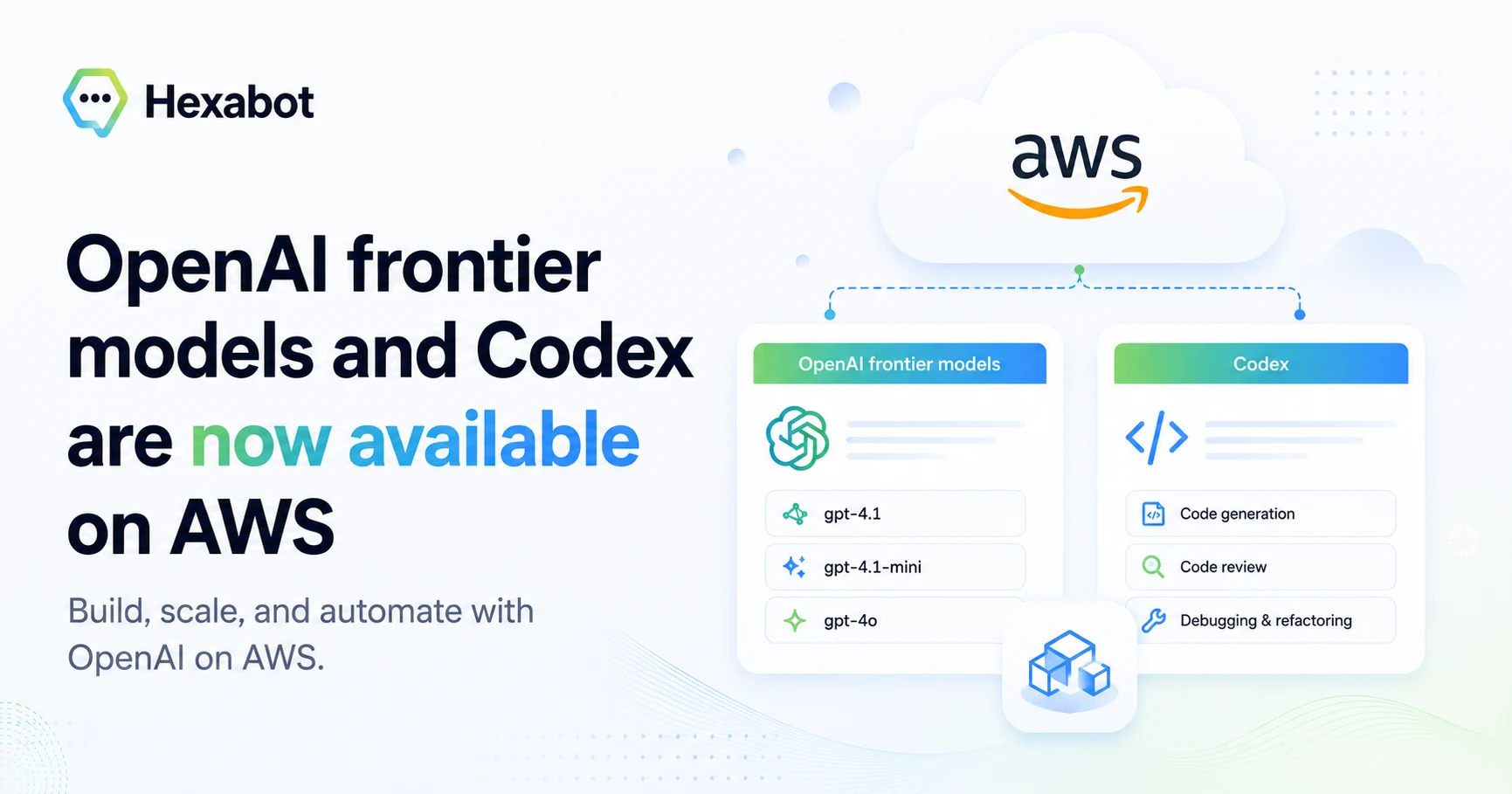
OpenAI announced that OpenAI frontier models and Codex are generally available on AWS. According to OpenAI, this gives enterprises a new way to access OpenAI capabilities through existing AWS security, compliance, procurement, billing, and governance workflows. (OpenAI)
The availability is structured around two main paths:
First, OpenAI models are available through Amazon Bedrock, allowing teams to build AI applications using AWS-native security and governance controls. Second, Codex is available through Amazon Bedrock, bringing OpenAI’s software engineering agent into AWS-based development environments. (OpenAI)
This distinction is important. OpenAI models on AWS are mainly about building applications with frontier model capabilities. Codex on AWS is about helping engineering teams write, review, debug, and modernize code in environments that are already governed through AWS. (OpenAI)
Why this matters for enterprise AI
Many companies already run their infrastructure on AWS. Their teams use AWS for compute, storage, networking, identity, monitoring, compliance, and procurement. But until now, adopting a frontier AI provider often meant introducing a new vendor path, a new billing relationship, a new security review, and sometimes a new data governance process.
That does not necessarily stop innovation, but it slows it down.
When AI tools are outside the existing enterprise operating model, teams often face questions such as:
Can we approve this vendor? Where is the data processed? How do we manage identity and access? Who owns billing? Can this fit our compliance framework? Can we monitor and govern usage centrally? Is this approved for production workloads?
By making OpenAI capabilities available through AWS, the announcement directly addresses that operational gap. OpenAI’s own framing emphasizes that customers can now bring OpenAI capabilities into AWS environments with controls their teams already trust. (OpenAI)
In other words, the value is not only “better models.” The value is making advanced AI easier to adopt inside real enterprise constraints.
OpenAI models on Amazon Bedrock
Amazon Bedrock provides a managed way to access supported OpenAI models through AWS infrastructure. OpenAI’s developer documentation explains that this path is useful for organizations that want procurement, identity, regional controls, and related cloud operations to remain inside AWS. (OpenAI Developers)
From an application architecture perspective, this means teams can build AI applications using OpenAI model behavior while relying on AWS for the surrounding cloud control plane, including account access, regional availability, and billing. (OpenAI Developers)
For developers, OpenAI’s documentation describes a Bedrock-aware SDK client. Instead of using the default OpenAI client, applications can instantiate BedrockOpenAI, select an AWS Region, and call supported OpenAI model IDs such as openai.gpt-5.5. The documentation gives us-east-2 as the initial deployment region example for openai.gpt-5.5. (OpenAI Developers)
This is useful for teams that want to keep AI workloads close to their existing AWS deployment patterns. It also gives cloud teams a more familiar operational model for access control, quota management, billing, and support workflows.
Codex on Amazon Bedrock
The second part of the announcement is Codex on Amazon Bedrock.
Codex is OpenAI’s software engineering agent. With AWS availability, teams can configure Codex to use OpenAI models served through Amazon Bedrock. OpenAI’s Codex documentation explains that, in this setup, Codex runs locally and sends model requests to Bedrock using AWS-managed authentication and access controls. (OpenAI Developers)
This is an important architectural point. When Codex is configured with Amazon Bedrock as the provider, the OpenAI-hosted Responses API is not in the request path. Instead, Codex sends requests to Amazon Bedrock, and Bedrock provides a compatible Responses API implementation for supported OpenAI models. (OpenAI Developers)
Authentication is also different. OpenAI’s documentation states that users authenticate with a Bedrock API key or AWS IAM credentials, rather than using ChatGPT sign-in or an OPENAI_API_KEY for this provider. (OpenAI Developers)
For enterprises, that can make a major difference. Engineering leaders can evaluate AI coding assistance while keeping identity, access, and operational control aligned with the way their organization already manages AWS resources.
The bigger picture: AI is moving into governed production environments
The first wave of generative AI adoption was often experimental. Teams tested chat interfaces, prompt libraries, internal copilots, and early automation prototypes. The goal was learning what large language models could do.
The next wave is different.
Companies now want AI systems that can operate inside production workflows. That means AI must respect security boundaries, integrate with business systems, follow approval processes, produce auditable outputs, and work reliably at scale.
This is where cloud availability becomes strategically important. When frontier models are accessible through existing cloud infrastructure, AI becomes easier to embed into real business systems: customer support, internal knowledge assistants, document processing, software engineering, compliance workflows, analytics, and operational automation.
The announcement also confirms a direction that many enterprise AI teams are already taking: AI adoption is no longer only about choosing a model. It is about choosing the right operating environment for AI.
How to use an OpenAI frontier model with Amazon Bedrock
What developers should pay attention to
For developers, the AWS path is promising, but it does not mean every OpenAI API feature is automatically available through Amazon Bedrock.
OpenAI’s documentation clearly states that Amazon Bedrock availability differs from the OpenAI API and that teams should confirm the supported model, AWS Region, feature set, and pricing path before deploying a workload. (OpenAI Developers)
The initial Amazon Bedrock offering supports a subset of Responses API capabilities. For example, OpenAI’s documentation lists text generation, image input, file input for supported file types, structured outputs, function calling, streaming responses, reasoning effort, prompt caching, custom tools, and client-side tool search as available through Bedrock at initial availability. However, it also lists several OpenAI-hosted tools and service features as unavailable in the initial Bedrock offering, including hosted web search, hosted file search, computer use, shell tool, image generation tool, remote MCP servers, WebSocket connections, and service tiers beyond on-demand inference. (OpenAI Developers)
That means teams should treat AWS availability as a deployment option, not as a perfect mirror of the full OpenAI platform.
The practical question is not: “Is OpenAI available on AWS?” The better question is: “Does the AWS path support the exact model, region, feature set, latency profile, pricing model, and governance needs of our workload?”
What this means for AI workflow automation
This announcement is especially relevant for AI workflow automation.
AI workflows usually combine several components: models, tools, business logic, APIs, databases, user approvals, logs, permissions, retries, and monitoring. In production, the model is only one part of the system.
If an organization can access frontier models from within AWS, it becomes easier to connect AI reasoning with cloud-native infrastructure and business systems. For example, a workflow could classify incoming requests, extract information from documents, call internal APIs, create tickets, update CRM records, summarize conversations, or assist developers with code reviews.
But the same production principles still apply. Teams need to design workflows carefully. Deterministic business logic should not always be delegated to the model. Sensitive actions should require proper validation. Human approval should be included where risk is high. Observability should be built in from the beginning. Cost controls should be part of the architecture, not an afterthought.
In that sense, OpenAI on AWS strengthens the infrastructure layer, but companies still need an orchestration layer to turn model access into reliable business automation.
What about security and cyber use cases?
OpenAI also mentioned future availability for Daybreak, its vision for improving how software is built and defended. The announcement says Daybreak includes cyber models and Codex Security, with capabilities intended to support secure code review, threat modeling, patch validation, dependency risk analysis, detection, and remediation guidance in the development loop. (OpenAI)
For engineering organizations, this points to a future where AI coding agents are not only used to generate code faster, but also to improve software quality and resilience. The key idea is to bring AI assistance closer to the everyday development lifecycle, from writing code to reviewing risks and improving maintainability.
This is particularly important because software teams are under pressure to ship faster while maintaining security and reliability. AI agents can help, but only when they are governed, observable, and integrated into the team’s existing engineering process.
AWS availability does not remove the need for architecture
One mistake companies often make with AI is assuming that model access is the whole solution.
It is not.
Access to frontier models is powerful, but production AI requires more than prompts and API calls. Teams still need to answer architectural questions:
What data can the model access? Which tools can it call? Which actions require approval? How are outputs validated? How are costs monitored? How are errors handled? How are workflows versioned? How are logs reviewed? How do we prevent the model from performing unnecessary reasoning for deterministic tasks?
The AWS announcement helps with enterprise access and governance, but the responsibility for system design remains with builders. The organizations that benefit most will be the ones that combine frontier model capabilities with clear workflow design, robust integrations, and strong operational controls.
A practical framework for teams evaluating OpenAI on AWS
For teams considering this new deployment path, a practical evaluation should include five areas.
Start with the use case. A coding assistant, a document processing workflow, a customer support agent, and an internal analytics assistant will not have the same requirements.
Then validate model and region availability. OpenAI’s documentation notes that Bedrock availability depends on AWS Region and model, and that the initial launch scope is more limited than the OpenAI API. (OpenAI Developers)
Next, check feature coverage. Some workloads need function calling and structured outputs. Others may depend on hosted tools, remote MCP servers, or specialized capabilities that may not be available in the initial Bedrock path. (OpenAI Developers)
After that, compare pricing and operations. OpenAI’s documentation states that AWS bills Amazon Bedrock usage and that Bedrock-specific pricing may differ from direct OpenAI API pricing. (OpenAI Developers)
Finally, design the workflow architecture. Decide which parts should be handled by the model, which parts should be implemented as deterministic actions, which parts require human review, and how the full process will be monitored.
How to use an OpenAI model from Amazon Bedrock inside a Hexabot workflow
One of the most practical implications of OpenAI models becoming available on AWS is that AI automation builders can use these models inside governed, production-oriented workflows — not only through raw API calls.
In Hexabot, this can be done directly from the workflow builder by adding an AI Agent step and configuring its model provider to use Amazon Bedrock.
Instead of writing custom integration code for every workflow, teams can define a reusable model configuration, attach it to an AI Agent step, and combine it with other workflow actions such as data collection, content generation, database operations, API calls, human review, or publishing steps.
This is especially useful for enterprise AI automation because OpenAI’s AWS availability is designed to help organizations bring frontier AI into production through existing AWS security, compliance, procurement, billing, and governance workflows. OpenAI describes Amazon Bedrock as one of the two main ways AWS customers can access OpenAI capabilities, alongside Codex on Amazon Bedrock.
Example: adding an AI Agent step in Hexabot
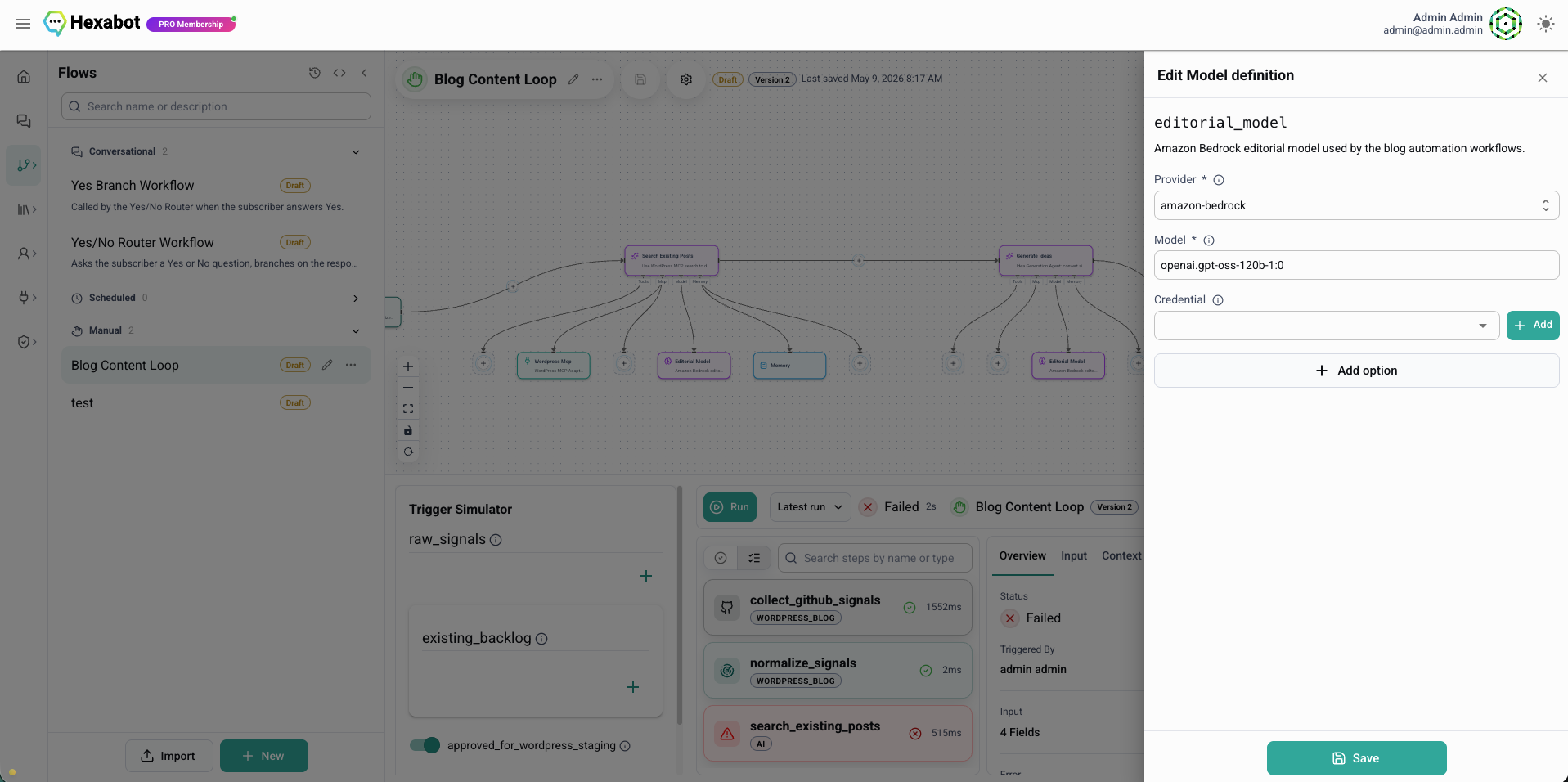
A typical setup could look like this:
-
Create or open a workflow in Hexabot.
-
Add an AI Agent step where reasoning, generation, summarization, classification, or decision-making is required.
-
Open the model configuration panel.
-
Select Amazon Bedrock as the provider.
-
Choose the OpenAI model exposed through your AWS Bedrock account.
-
Attach the appropriate AWS credential.
-
Save the model definition.
-
Run the workflow and inspect the execution logs.
For example, in a blog automation workflow, the AI Agent could be used to generate article ideas, rewrite content, summarize research signals, classify topics, or prepare a draft for editorial review. The workflow can then continue with deterministic steps such as storing data, calling WordPress APIs, checking approval status, or notifying a human reviewer.
This is where the workflow approach becomes powerful: the AI model is not responsible for everything. It is used where language understanding and generation are valuable, while the rest of the process remains structured, observable, and controlled.
Configuring the model definition
Inside the Hexabot model definition panel, the configuration can include:
-
Provider:
amazon-bedrock -
Model: the OpenAI model identifier available in Amazon Bedrock
-
Credential: the AWS or Bedrock credential configured for the workspace
In the example workflow, the model definition is named editorial_model, making it clear that this model is intended for editorial automation tasks. This kind of naming is useful when a workspace contains multiple models for different purposes, such as support automation, content generation, technical analysis, or internal knowledge workflows.
The important point is that the AI Agent step does not need to know the low-level details of Amazon Bedrock. The workflow builder simply references the configured model definition and uses it as part of the automation flow.
Why this matters for production AI
This UI-based approach is important because many enterprise AI use cases are not just “send a prompt and get a response.” Real business workflows usually involve several steps:
-
A trigger starts the workflow.
-
Data is collected from one or more systems.
-
An AI Agent analyzes or generates content.
-
The result is validated against business rules.
-
A condition decides the next path.
-
A human may approve the output.
-
An API call updates an external system.
-
The workflow stores logs and execution results.
By making OpenAI models available through Amazon Bedrock, teams can connect powerful model capabilities with AWS-native governance and then orchestrate them visually inside Hexabot. OpenAI notes that Bedrock availability helps teams use OpenAI capabilities through AWS environments they already trust for security, compliance, procurement, billing, and governance.
However, teams should still validate model availability, region support, pricing, and feature coverage before using this in production. OpenAI’s developer documentation notes that Amazon Bedrock availability is not identical to the direct OpenAI API, so builders should confirm that the required model and features are supported for their specific workload.
From model access to real automation
The main benefit is not only that OpenAI models are available on AWS. The real value appears when those models are integrated into structured workflows.
For example, a Hexabot workflow could use an OpenAI model on Amazon Bedrock to:
-
classify incoming customer requests,
-
generate a response draft,
-
summarize documents,
-
extract structured information,
-
produce blog article outlines,
-
review support tickets,
-
prepare internal reports,
-
or decide whether a case should be escalated to a human.
The AI Agent handles the flexible reasoning or language generation part, while Hexabot orchestrates the surrounding business process. This gives teams a more reliable way to move from experimentation to production AI automation.
Conclusion
OpenAI frontier models and Codex becoming available on AWS is a major step for enterprise AI adoption. It brings advanced model capabilities closer to the cloud environments where many organizations already manage infrastructure, security, procurement, billing, and governance.
For business leaders, this lowers the operational barrier to adopting frontier AI. For developers, it creates a more familiar path to build AI applications and coding workflows using AWS-managed controls. For AI automation teams, it reinforces a bigger lesson: the future of AI is not just about smarter models, but about putting those models into reliable, governed, production-ready workflows.
The winners in this next phase will not simply be the companies that experiment with AI the fastest. They will be the companies that build the strongest bridge between AI capability and operational execution.