Why Production AI Needs More Than Prompts and Tools
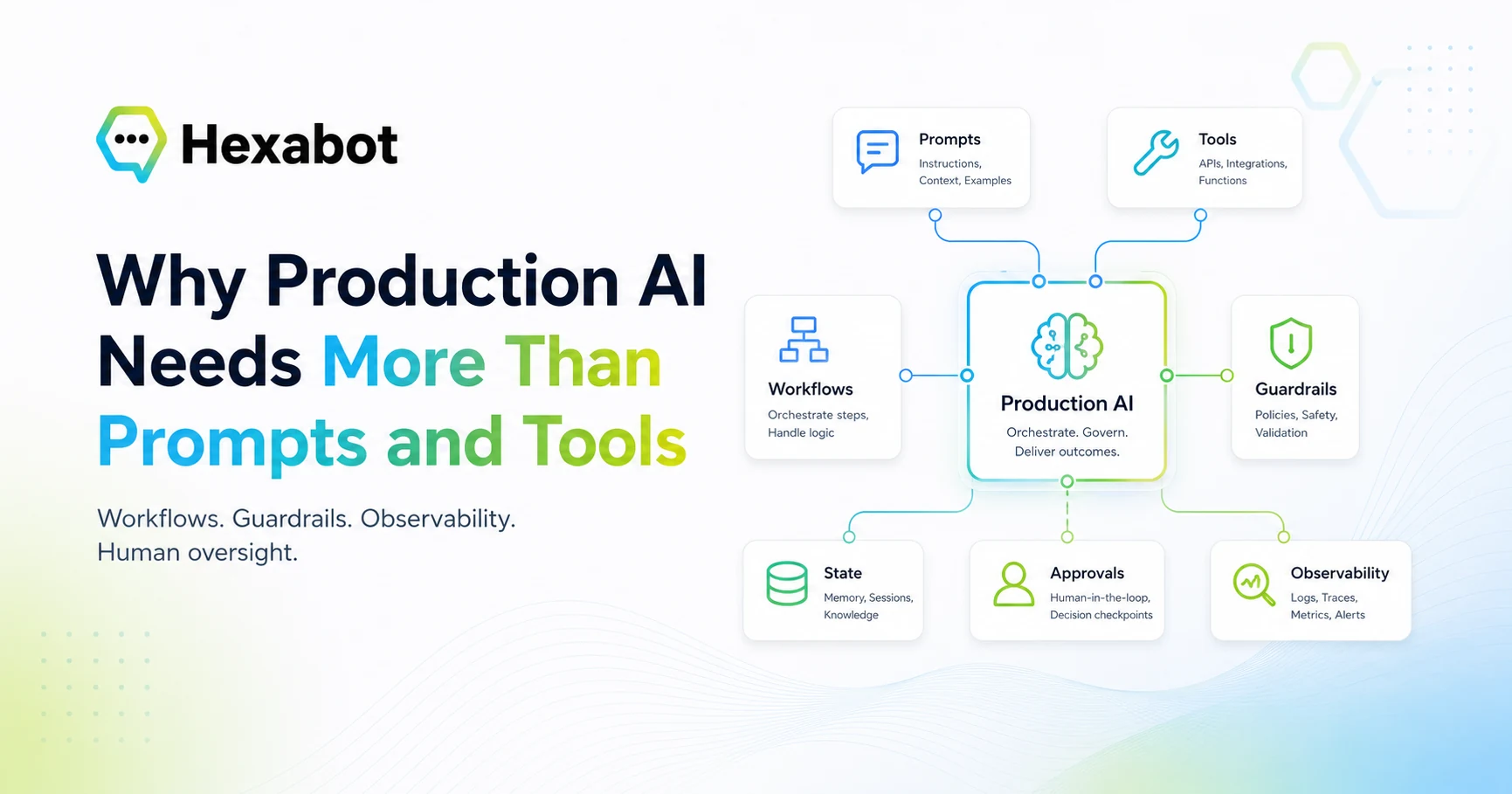
Prompts and tools are useful for AI prototypes, but production AI needs workflows, validation, observability, and human oversight to become reliable.

AI prototypes have become surprisingly easy to build.
You write a prompt. You connect an LLM to a few tools. You add access to documents, APIs, or a database. You run a demo. It works.
At least, it works once.
Then comes production.
A customer asks the same question in a slightly different way. A tool returns unexpected data. The model chooses the wrong action. The workflow gets stuck. The response is technically correct but operationally useless. The cost per task becomes too high. A human operator asks, “Why did the AI do that?” and nobody has a clear answer.
This is where many AI projects start to fail.
Not because the model is weak. Not because the prompt is bad. Not because tools are useless. But because production AI is not just a prompting problem. It is a system design problem.
Modern AI applications can use tool calling to connect language models with external systems, APIs, databases, and business actions. OpenAI describes function calling as a way for models to interface with external systems through tools defined by schemas. (OpenAI Developers) Structured outputs can also help force model responses to follow a JSON schema, which reduces some formatting and validation issues. (OpenAI Developers) But even with these capabilities, production AI still needs workflow logic, governance, observability, evaluation, state management, and human oversight.
In other words, prompts and tools are only the beginning.
The Prototype Illusion
Most AI demos follow a simple pattern:
-
Give the model instructions.
-
Provide context.
-
Let the model call tools.
-
Return an answer.
This is powerful because LLMs are flexible. They can interpret natural language, reason over context, decide which tool to use, and generate a human-friendly response.
For a demo, this feels magical.
For production, magic is not enough.
A production system has to deal with repeated usage, edge cases, user permissions, failed API calls, security constraints, business rules, audit logs, cost limits, and performance expectations. It also has to behave consistently enough that a team can trust it.
This is the difference between an AI that can do something and an AI system that can be operated.
The first one impresses people. The second one creates business value.
Prompts Are Instructions, Not Architecture
Prompts are essential. They define the role of the AI, the tone of the response, the expected behavior, and the boundaries of the task.
But prompts are not a substitute for architecture.
A prompt can say:
“If the customer has a billing issue, check their account, classify the urgency, create a ticket if needed, and escalate high-priority cases to a human.”
That sounds clear. But in production, each part of that sentence hides multiple technical and operational questions.
How do we classify the issue? Which account system should be queried? What happens if the customer is not found? What fields are required to create a ticket? Who decides whether the case is urgent? What happens if the ticketing API fails? Should the user be notified before escalation? Should a human approve the action? How do we log what happened?
A prompt can describe the desired behavior. But it cannot, by itself, guarantee that the behavior will happen correctly every time.
That is why production AI needs a layer of explicit workflow design around the model.
Tools Let AI Act, But They Also Increase Risk
Tool use is one of the biggest shifts in AI development.
Instead of only generating text, AI systems can now call APIs, search databases, update records, send emails, create tickets, analyze files, trigger automations, and interact with external applications.
This is what turns a chatbot into an AI agent.
But the moment an AI system can act, the risks become much higher.
A wrong answer is one problem. A wrong action is another.
If an AI assistant gives a vague answer, the user may ignore it. But if it updates the wrong customer record, sends the wrong email, cancels the wrong request, or escalates the wrong case, the impact becomes operational.
Anthropic’s engineering guidance on tools for agents emphasizes that tool design matters: teams need to choose the right tools, define clear boundaries, return meaningful context, and optimize tool responses for token efficiency. (Anthropic) In another engineering note, Anthropic highlights that bloated or ambiguous tool sets can become a failure mode: when even a human engineer cannot clearly choose the right tool for a situation, an AI agent should not be expected to do better. (Anthropic)
This is a key lesson for production AI:
Giving an AI more tools does not automatically make it more capable. Sometimes it makes it less reliable.
The goal is not to connect every possible tool. The goal is to expose the right actions, with clear inputs, clear outputs, and clear rules.
Production AI Needs Workflow Logic
Many business processes are not purely open-ended reasoning problems.
They are structured workflows.
For example, a customer support process may look like this:
flow:
  - classify_issue
  - check_customer_account
  - decide_priority
  - create_ticket
  - conditional:
      if: priority = "high"
      then:
        - escalate_to_human
      else:
        - send_confirmation
The AI may help classify the issue, summarize the request, or generate the final message. But the business process itself should not be left entirely to free-form model reasoning.
Some steps are better handled deterministically:
if customer.status = "inactive":
  route_to: retention_team

if invoice.amount > 1000:
  require_human_approval: true

if urgency = "high":
  escalate_to_human: true
This is where AI workflows become important.
A workflow gives structure to the AI system. It defines what should happen, in what order, under which conditions, and with which data.
The LLM becomes part of the system, not the whole system.
That distinction matters.
Production AI Needs State
A prompt is usually stateless unless you explicitly provide history or memory.
But real business processes often need state.
A production AI system may need to know:
Has this user already submitted the form? Was the previous step completed? Which tool was called? What was the result? Is the workflow waiting for human approval? Did the user confirm the action? Has the ticket already been created? Should the conversation continue from the last step?
Without state management, the AI may repeat actions, lose context, ask for the same information again, or make inconsistent decisions.
State is what allows an AI system to move from “chat response” to “process execution.”
For example, in a sales workflow, the AI may need to track:
{
  "lead_status": "qualified",
  "meeting_booked": false,
  "crm_record_created": true,
  "last_contact_channel": "email",
  "next_step": "schedule_demo"
}
This information should not live only inside the model’s temporary context window. It should be stored, updated, and used by the application.
Production AI needs memory, but not just conversational memory. It needs operational memory.
Production AI Needs Validation
LLMs are flexible, but business systems are strict.
An API does not accept “probably next Tuesday.” A payment system does not accept “around 100 dollars.” A database does not accept missing required fields. A workflow cannot continue if the expected output is malformed.
This is why validation is essential.
A production AI system should validate:
-
Inputs before sending them to the model.
-
Model outputs before using them.
-
Tool arguments before execution.
-
Tool responses before continuing.
-
User confirmations before sensitive actions.
-
Final responses before sending them to the user.
Structured outputs help here because they allow developers to require a specific JSON schema from the model. OpenAI’s documentation describes structured outputs as a way to ensure model responses adhere to a supplied JSON schema, including required keys and valid enum values. (OpenAI Developers)
But schema validation is only one layer.
A valid JSON object can still be wrong from a business perspective.
For example:
{
  "priority": "low",
  "should_escalate": false
}
This may be valid JSON. But if the customer is reporting a critical service outage, the classification may be wrong.
Production AI needs both technical validation and business validation.
Production AI Needs Human Oversight
Not every action should be fully automated.
Some decisions require human approval, especially when they involve financial impact, legal risk, customer trust, sensitive data, or irreversible actions.
A good production AI system should support human-in-the-loop workflows.
That means the AI can prepare the work, but a human can review, approve, reject, or modify the action before execution.
LangChain’s human-in-the-loop middleware, for example, is designed to pause execution when a tool call needs review, such as file writing or SQL execution, and wait for a human decision based on a configurable policy. (LangChain Docs)
This pattern is important because production AI should not be designed around blind autonomy.
A better model is controlled autonomy.
The AI can act independently where the risk is low. It can ask for confirmation where the risk is medium. It can require human approval where the risk is high.
This makes AI systems more practical, safer, and easier to adopt inside organizations.
Production AI Needs Observability
When a traditional application fails, engineers inspect logs, traces, metrics, and error messages.
When an AI system fails, the question is harder:
Why did the model answer that way? Which context did it see? Which tool did it choose? What arguments did it send? What did the tool return? Which step failed? Was the prompt followed? Was the data outdated? Was the output evaluated?
Production AI needs observability because AI failures are not always obvious.
An API error is visible. A hallucinated answer may look confident. A wrong classification may silently route the user to the wrong process. A tool call may succeed technically but fail operationally.
Google Cloud’s agent observability documentation describes observability as a way to understand the internal state and behavior of AI-powered agents, noting that agents can drift, hallucinate, regress silently, and take unexpected actions. (Google Cloud Documentation)
This is why production AI systems should track:
-
User input.
-
Prompt version.
-
Model used.
-
Retrieved context.
-
Tool calls.
-
Tool arguments.
-
Tool outputs.
-
Workflow steps.
-
Human interventions.
-
Final response.
-
Errors and retries.
-
Cost and token usage.
Without observability, improving an AI system becomes guesswork.
With observability, improvement becomes engineering.
Production AI Needs Evaluation
Testing one prompt manually is not enough.
A production AI system should be evaluated continuously.
That means testing whether the system gives correct answers, follows policies, calls the right tools, handles edge cases, respects formatting requirements, and produces useful outcomes.
Google Cloud introduced agent evaluation features in Vertex AI Gen AI evaluation service to help developers assess and understand AI agents using evaluation metrics designed for agentic systems. (Google Cloud) LangChain has also written about using automated evaluations on production data to monitor agents and surface cases that need human attention. (LangChain)
Evaluation matters because AI systems are probabilistic.
A normal software function should return the same output for the same input. An LLM-based system may produce different outputs depending on context, model version, temperature, prompt changes, retrieved documents, or tool responses.
So instead of asking, “Does it work?” we need to ask better questions:
Does it work across 500 realistic examples? Does it fail safely? Does it choose the right tool? Does it respect business rules? Does it avoid unnecessary tool calls? Does it produce valid structured outputs? Does it escalate when needed? Does it stay within acceptable cost? Does it improve over time?
Production AI needs evaluation because reliability cannot be based on vibes.
Production AI Needs Cost Control
In many AI prototypes, cost is ignored.
That is understandable. During experimentation, the goal is to prove that something is possible.
But in production, every token, tool call, retry, and reasoning step has a cost.
Agentic systems can become expensive when the model is asked to reason through every step of every process. If the AI has to decide everything dynamically, inspect long context, call multiple tools, analyze responses, retry failed calls, and generate detailed reasoning for repetitive tasks, the cost can scale quickly.
A better approach is to separate what should be handled by the model from what should be handled by code.
Use the LLM for:
-
Understanding natural language.
-
Extracting intent.
-
Summarizing information.
-
Generating human-friendly responses.
-
Handling ambiguous cases.
-
Making judgments when rules are not enough.
Use deterministic logic for:
-
API calls.
-
Data transformations.
-
Routing.
-
Validation.
-
Permissions.
-
Repetitive business rules.
-
Simple conditional decisions.
-
Formatting.
-
Retries.
-
Logging.
This does not make the system less intelligent.
It makes it more efficient.
The best production AI systems do not ask the LLM to do everything. They use the LLM where it creates the most value.
Production AI Needs Governance
In a company, humans do not work with total freedom.
They follow roles, procedures, permissions, escalation paths, quality checks, and reporting rules.
AI should be no different.
A production AI system needs governance.
That includes:
-
Who can trigger which workflow.
-
Which tools the AI can access.
-
Which data sources are allowed.
-
Which actions require approval.
-
Which logs must be stored.
-
Which prompts are in production.
-
Which model versions are allowed.
-
Which workflows are deprecated.
-
Which users can modify automations.
-
Which policies the AI must follow.
Without governance, an AI system becomes difficult to trust.
With governance, AI becomes part of the organization’s operating model.
This is especially important for businesses moving from simple AI assistants to AI workflow automation. The more the AI participates in real operations, the more it needs structure.
From AI Assistant to AI Operator
The first wave of AI adoption was mostly about assistance.
Write this email. Summarize this document. Generate this code. Answer this question. Help me brainstorm.
This assistant mode is useful. It gives every user a productivity boost.
But business automation requires something more.
An AI operator does not only answer. It helps execute a process.
It can receive an input, understand the goal, follow a workflow, call tools, transform data, respect rules, ask for approval, update systems, and produce a final outcome.
That requires more than a prompt.
It requires a production architecture.
The future of AI in business is not only “smarter chat.” It is structured, observable, governable AI workflows that combine LLM reasoning with deterministic software engineering.
A Simple Mental Model for Production AI
To understand what production AI needs, think of it as a stack.
At the bottom, you have the model.
The model gives the system language understanding, reasoning, generation, and flexibility.
Above the model, you have prompts.
Prompts give the model instructions, role, tone, constraints, and context.
Above prompts, you have tools.
Tools allow the model to interact with external systems and perform actions.
But above tools, production AI needs more layers:
Production AI System
├── Governance
├── Observability
├── Evaluation
├── Human approval
├── Workflow orchestration
├── State management
├── Validation
├── Tool execution
├── Prompting
└── LLM
Most failed AI projects stop at the bottom three layers:
LLM + Prompt + Tools
Most successful production AI systems keep going.
What This Means for Builders
If you are building AI automation for real users, the question is not only:
“How do I make the model smarter?”
The better question is:
“How do I make the system more reliable?”
That changes the way you design.
Instead of writing one giant prompt, you define smaller workflow steps.
Instead of giving the model access to every tool, you expose clear actions.
Instead of trusting every output, you validate it.
Instead of letting the model decide everything, you combine AI reasoning with business rules.
Instead of debugging conversations manually, you trace what happened.
Instead of shipping once, you continuously evaluate.
This is how AI moves from experimentation to production.
Conclusion: Prompts Start the Journey, Systems Deliver the Value
Prompts are powerful. Tools are powerful. LLMs are powerful.
But production AI needs more than power.
It needs structure.
A production AI system must be reliable enough for users, transparent enough for operators, controllable enough for managers, and flexible enough for real-world complexity.
That requires workflows, state, validation, observability, evaluation, governance, and human oversight.
The companies that succeed with AI will not be the ones that simply write better prompts. They will be the ones that design better systems around AI.
Because in production, intelligence alone is not enough.
Execution matters.
Where Hexabot Fits
Hexabot is a self-hosted, fair-core AI chatbot and workflow automation platform designed for teams that want to move beyond simple prompts and build structured AI automations. With Hexabot, developers can combine LLM-powered reasoning with explicit workflows, reusable actions, channels, structured logic, and integrations, making it easier to design AI systems that are practical, controllable, and ready for real business use.
Learn more about Hexabot here: Hexabot.ai